
The wanting economy
GLP-1s are turning down the cravings consumer culture was built to stimulate

Did you see that Mounjaro is now the world’s best-selling medication? It generated US$8.7 billion for maker Eli Lilly in the first quarter of 2026, surpassing Merck & Co.’s cancer therapy Keytruda. Originally approved to treat diabetes, GLP-1s like Mounjaro have been found to help manage obesity and improve a host of other conditions including cardiovascular risk. But the more interesting possibility is they may not just change how full people feel, they may change the intensity of wanting itself.
For decades, the standard advice for anyone who couldn’t resist the snack aisle was to ‘try harder’. To exert more discipline. GLP-1 users describe something different, saying that they’re resisting cravings but that the cravings just aren’t there.
The effect appears to extend beyond food. There’s growing evidence that GLP-1 drugs can suppress alcohol cravings among heavy drinkers, with users spending 14.5% less in the category and nonalcoholic wine and beer purchases increasing by 1,158% and 935% respectively. It seems like GLP-1s don’t just remove food noise, they quiet alcohol noise too.
Researchers are also studying whether GLP-1s can reduce substance abuse. Early evidence suggests they may help with gambling. Then there are harder-to-categorise anecdotes, like the user who said Wegovy seemed to curb their shopping entirely because they no longer felt compelled to buy random things. The emotional pull to purchase disappeared.
Scientists still don’t fully understand why GLP-1s appear to have this range of effects, and the drugs come with well-documented side effects including nausea and gastrointestinal problems. But it seems like they may do more than signal fullness and act on brain circuits involved in wanting. In short: they act on what makes you want the cake, not just what makes you feel full 🎂. This builds on previous research conducted in the 1980s (!) by Kent Berridge, a neuroscientist at the University of Michigan, who helped separate ‘wanting’ from ‘liking’: the motivation to pursue something from the pleasure of actually having it.
So a drug that started as a diabetes treatment is now being described as an ‘anti consumption agent’. Anti-consumption typically has a moral through line. Whether it’s Dry January, detoxing or no-buy challenges, the premise is that wanting too much is a problem to be managed through discipline. ‘Wanting’ is a character flaw that can – if only you try hard enough! – be resisted. But GLP1s seem to turn the wanting down.
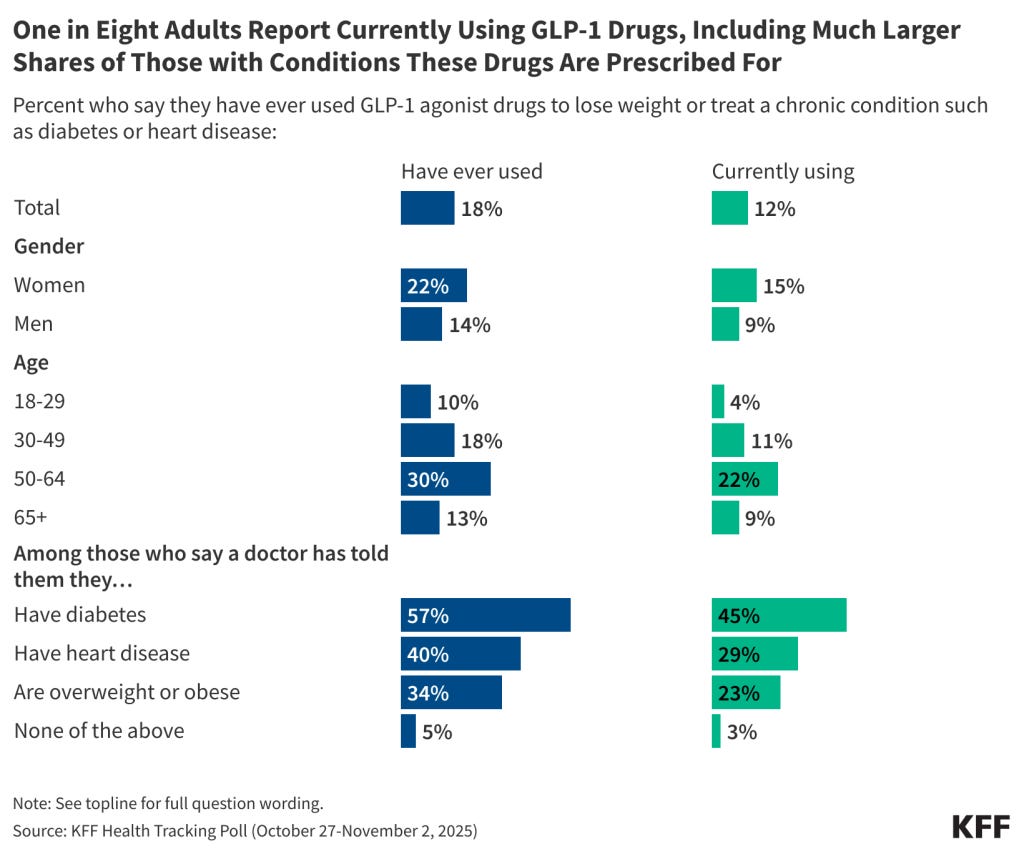
One in eight Americans is currently using a GLP-1, a number that’s projected to grow significantly in the coming years. Paediatric prescribing is on the rise in the US (more on that here). And medical advances, like daily pills, could scale up usage. That means a growing share of consumers may experience less of the low-level wanting that much of the consumer economy was designed to stimulate – things like snacks at the checkout, limited drops, dopamine-designed feeds. The commercial question is obvious. What happens when people want less? The more interesting question is what that wanting was doing for them in the first place.
For most users, GLP-1 drugs appeal because they quiet the noise in their head, the voice that has them calculating if they can stop at the supermarket on the way home for the cupcakes they deliberately didn’t put in their basket.
Some others report something more drastic. ‘Ozempic personality’ is a new-ish cultural shorthand for a more complicated and still-contested set of reports: not just fewer cravings, but a broader emotional flattening, including less excitement around food, shopping, drinking or other things they used to look forward to (the clinical term for this is anhedonia, a reduced ability to experience pleasure in activities that once brought joy).
That matters because the same week Mounjaro became the world’s top-selling drug, researchers published evidence that restoring the ability to feel pleasure, rather than reducing negative feelings, may be the most effective way to treat depression. Reducing compulsive cravings can improve people’s lives. But flattening the ability to look forward to things is something different.
The lure of the checkout snack and the craving to book a holiday aren’t the same thing. Neither are the impulse buy, the second drink or the small treat after a bad day. But they may draw on some of the same circuitry: anticipation, reward, relief and the promise of feeling different for a moment. Which makes the old willpower story feel too small.
Wanting was never only the enemy. Sometimes it was noise: the engineered craving for the snack, the haul, the scroll, the thing you didn’t really need but felt pulled towards anyway. But sometimes it was trying to do something more human: soothe, reward, distract, express identity or create a small moment of pleasure.
For decades, consumer culture monetised that pull while wellness culture moralised it. One said give in and sold the snack, the haul, the impulse buy. The other said resist and sold the diet, the detox, the discipline. Neither asked what people were really trying to get from the wanting.
Now GLP-1s are turning some of that wanting down. The interesting question is not only which industries suffer when people want less. It is what becomes clearer when the wanting quiets: which cravings were empty loops, and which were imperfect ways of meeting needs that are still there.
—
PS: On the subject of pleasure, this week I saw Les Liaisons Dangereuses at the National Theatre which is seductive, scheming and sumptuous. Personally, I loved the choreographed movement segments that helped reinforce the underlying themes and the text was funnier that I was expecting.
Go on, you know you want to…